Convert Knitting Gauge: Stitches, Rows and Repeats
Stitches = finished width in centimetres × stitches per 10 cm ÷ 10. At 22 stitches per 10 cm, a 50 cm panel needs 110 stitches before any repeat adjustment. Use the knitting gauge calculator to calculate stitches and optional rows, then compare the estimated size after rounding.
Try it free: Knitting gauge calculator Free to use, no account needed.
Measure a useful swatch
Use the yarn, needles and stitch pattern intended for your project. Measure inside a larger swatch, away from its edges, and check it after washing and drying. Match the working method too: flat and circular knitting can produce different tension. The Knitting & Crochet Guild's swatch guide explains these measurement considerations.
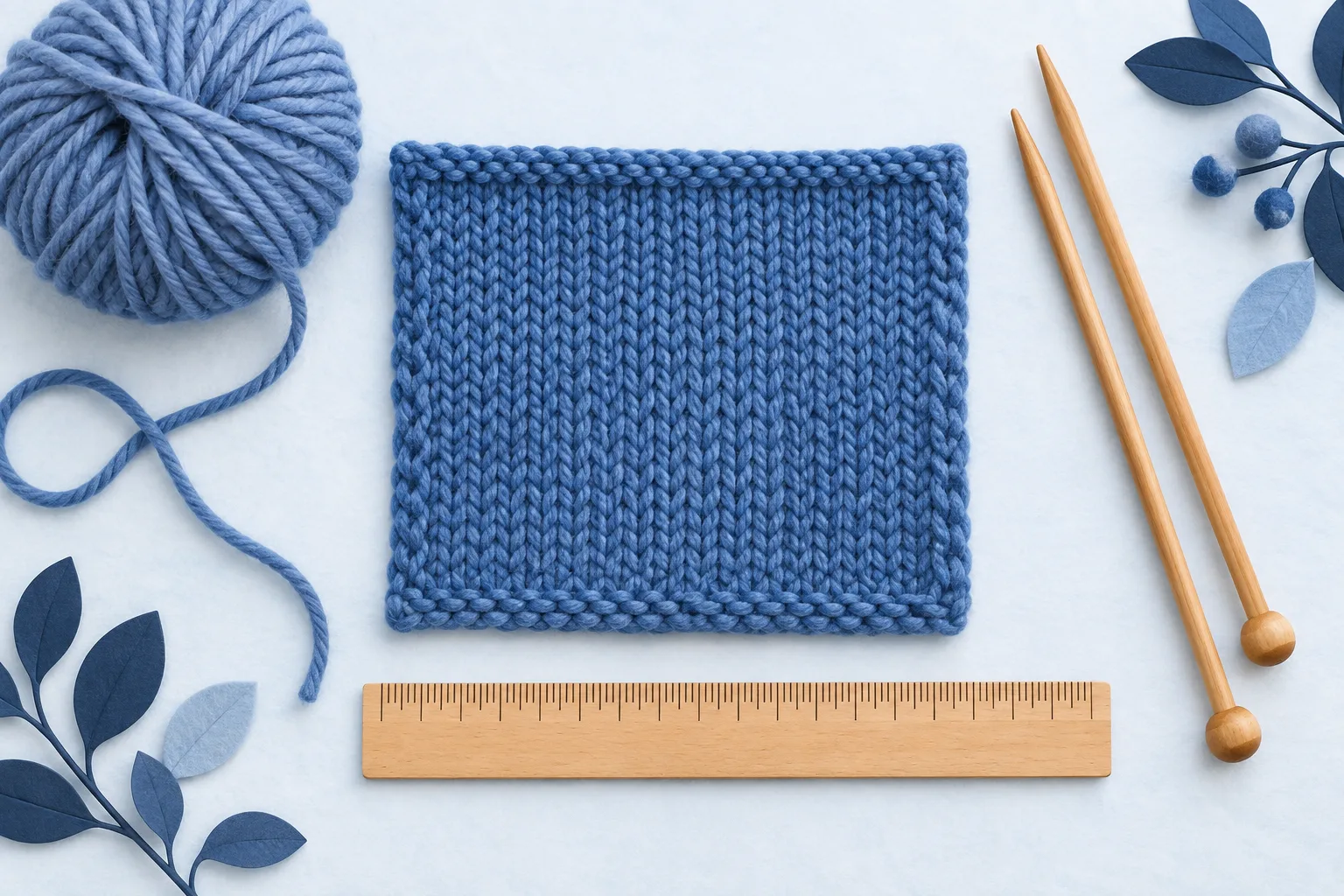
This calculator uses centimetres and gauge per 10 cm. Decimal points and commas are accepted, such as 22.5 or 22,5; do not use thousands separators. If your gauge is measured over 4 inches, convert it first: 4 inches is 10.16 cm, not exactly 10 cm.
Calculate from finished measurements
Choose From finished measurements, enter your stitch gauge and the width of the piece you are making. For a scarf, use its whole width. For a garment panel, use that panel's intended finished width, not automatically the wearer's body circumference. Decide on ease separately.
| Input | Example | Purpose |
|---|---|---|
| Your stitches per 10 cm | 22 | Measured stitch density |
| Finished width | 50 cm | Width of this piece |
| Your rows per 10 cm | 30 | Needed only for a height calculation |
| Finished height | 40 cm | Produces 120 rows before rounding |
With repeat 1 and no extra stitches, these inputs produce 110 stitches and 120 rows. Leave height blank for stitches only. The calculator never guesses row gauge from stitch gauge.
Adapt a pattern to your gauge
Choose Adapt a pattern. A pattern with 22 stitches per 10 cm and a count of 110 implies a 50 cm width. If your own gauge is 24 stitches per 10 cm, that width needs 120 stitches before repeat adjustment.
New stitch count = pattern stitch count × your gauge ÷ pattern gauge.
For rows, enter the pattern's row count and row gauge, together with your own row gauge. A pattern count of 120 rows at 30 rows per 10 cm becomes 128 rows at 32 rows per 10 cm, preserving a calculated 40 cm height.
This preserves simple dimensions, not an entire garment's construction. Necklines, raglan increases, sleeve caps and the placement of shaping require separate decisions. Do not scale every instruction mechanically.
Understand repeats and extra stitches
A repeat of 8 stitches plus 2 extra edge stitches permits counts such as 14 × 8 + 2 = 114 stitches. Open Pattern repeat and rounding to enter your repeat and the total additional stitches outside those repeats. Include both edges and any other fixed stitches; do not enter the number for just one side. Use repeat 1 and extras 0 for plain knitting without added stitches.
At 22 stitches per 10 cm, a requested 51 cm width gives an unrounded count of 112.2. An 8-stitch repeat and 2 extra stitches allow these neighbouring choices:
| Choice | Stitches | Estimated width |
|---|---|---|
| Round down | 106 | 48.18 cm |
| Nearest / Round up | 114 | 51.82 cm |
Nearest chooses the larger count when two counts are equally close. At least one whole repeat is required. If rounding down cannot fit a positive repeat count, the calculator explains the problem instead of silently rounding up.
The estimated width includes extra stitches and assumes the same gauge across all stitches. A differently worked border can change the real width. Rows round independently to the nearest whole row; row repeats are not applied.
Common questions
Why does editing an input clear my result?
The previous plan belongs to the previous measurements. Select Calculate stitches again after editing. This keeps the copied plan consistent with the visible inputs.
Are measurements saved or uploaded?
Calculations run in this tab, without persistent storage or an upload to a calculation service. Copy plan explicitly copies your result to the clipboard. Ads and other site services make separate network requests.
Can it calculate yarn quantity or guarantee fit?
No. Stitch counts alone do not establish yarn consumption, fabric behaviour, shaping or garment ease. Check the finished-size estimate and plan those details separately.
What limits apply?
Gauge values must be greater than zero and at most 500 stitches or rows per 10 cm. Dimensions are limited to 1,000 cm, and pattern counts to 100,000 whole stitches or rows. Repeats accept 1–1,000 stitches and extra stitches 0–1,000. These are input limits, not recommended project dimensions.
Open the knitting gauge calculator and try the scarf example before entering your own measurements.
About this guide
This guide describes the TimeToTime calculator and its limits. The text and illustration were created with AI assistance. The illustration is not a measurement template; the examples are checked arithmetic, not tested knitting patterns. Specialist knitting review remains pending.
Try it free: Knitting gauge calculator Free to use, no account needed.